When to Book, What to Expect and Signs Every Parent Should Know
Your child passed every school screening. But something still feels slightly off. They squint at the board, they hold their tablet uncomfortably close, and they seem to struggle more than other children with reading.
Vision problems in children are often invisible until they are not. And by the time a teacher or parent notices something, a child has often been quietly compensating for months, sometimes years.
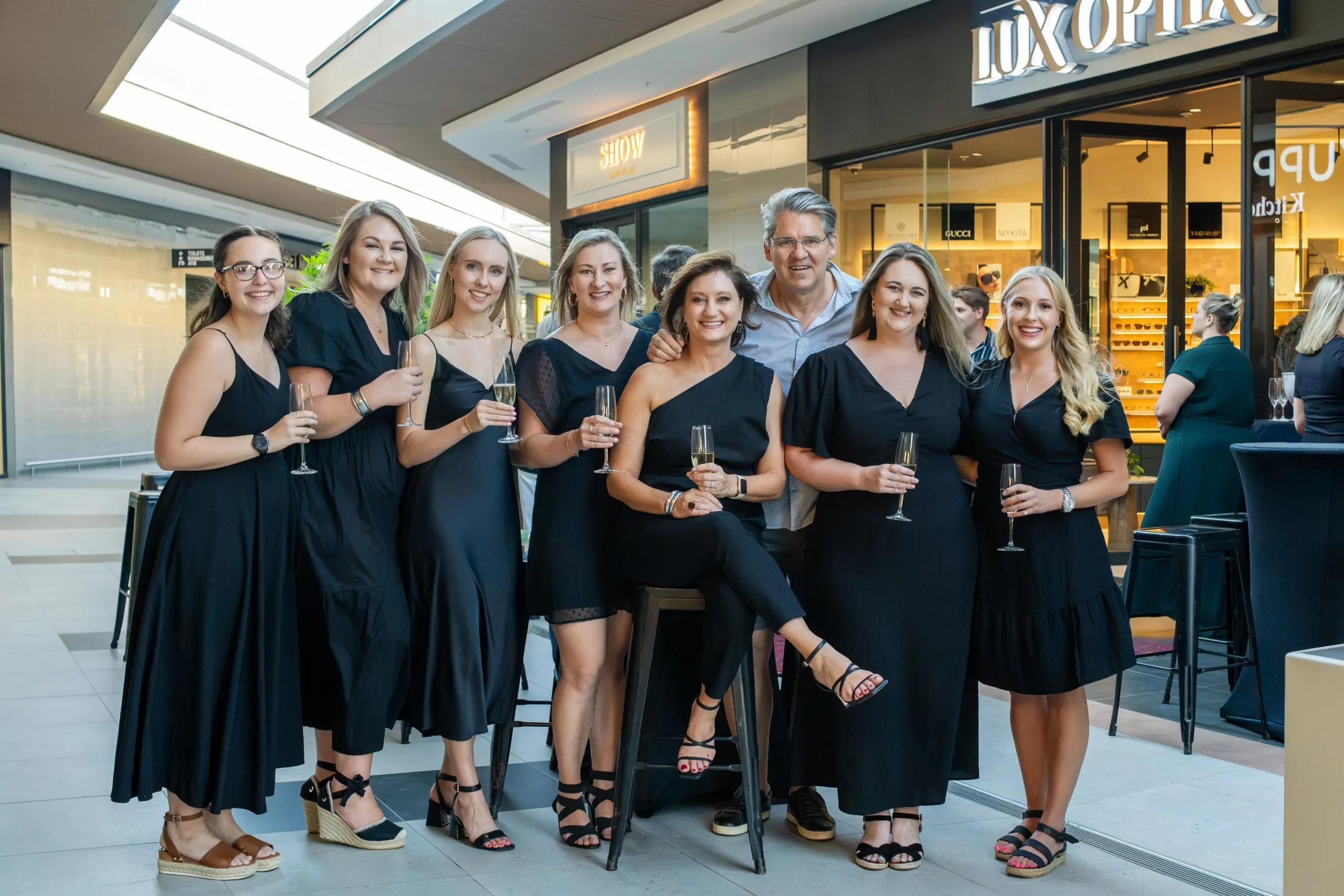
At Reza Ferreira Boutique Optometrists in Paarl, we test children of all ages, from toddlers to teenagers, and what we find regularly surprises parents. This guide covers everything Paarl families need to know: when to start, what to expect, which warning signs to watch for, and why early testing is one of the most valuable things you can do for your child’s development.
There Is No Minimum Age for a Children’s Eye Test
One of the most common questions we hear from Paarl parents is: “Is my child old enough for an eye test?”
The answer is simple: there is no minimum age.
Our optometrists, Channáh du Plessis and Reza Ferreira, conduct children’s eye tests at our Paarl practice. Channáh explains it this way: the tests we perform on very young children are simply more objective. Rather than relying on verbal responses, we use clinical techniques that allow us to assess a young child’s vision without them needing to read a chart or answer questions. As children grow and develop language and comprehension, the assessment naturally becomes more interactive, but the ability to test is never the limiting factor.
If you have any concerns about your child’s eyes, no matter their age, it is always worth booking an appointment.
What a Children’s Eye Test Actually Covers
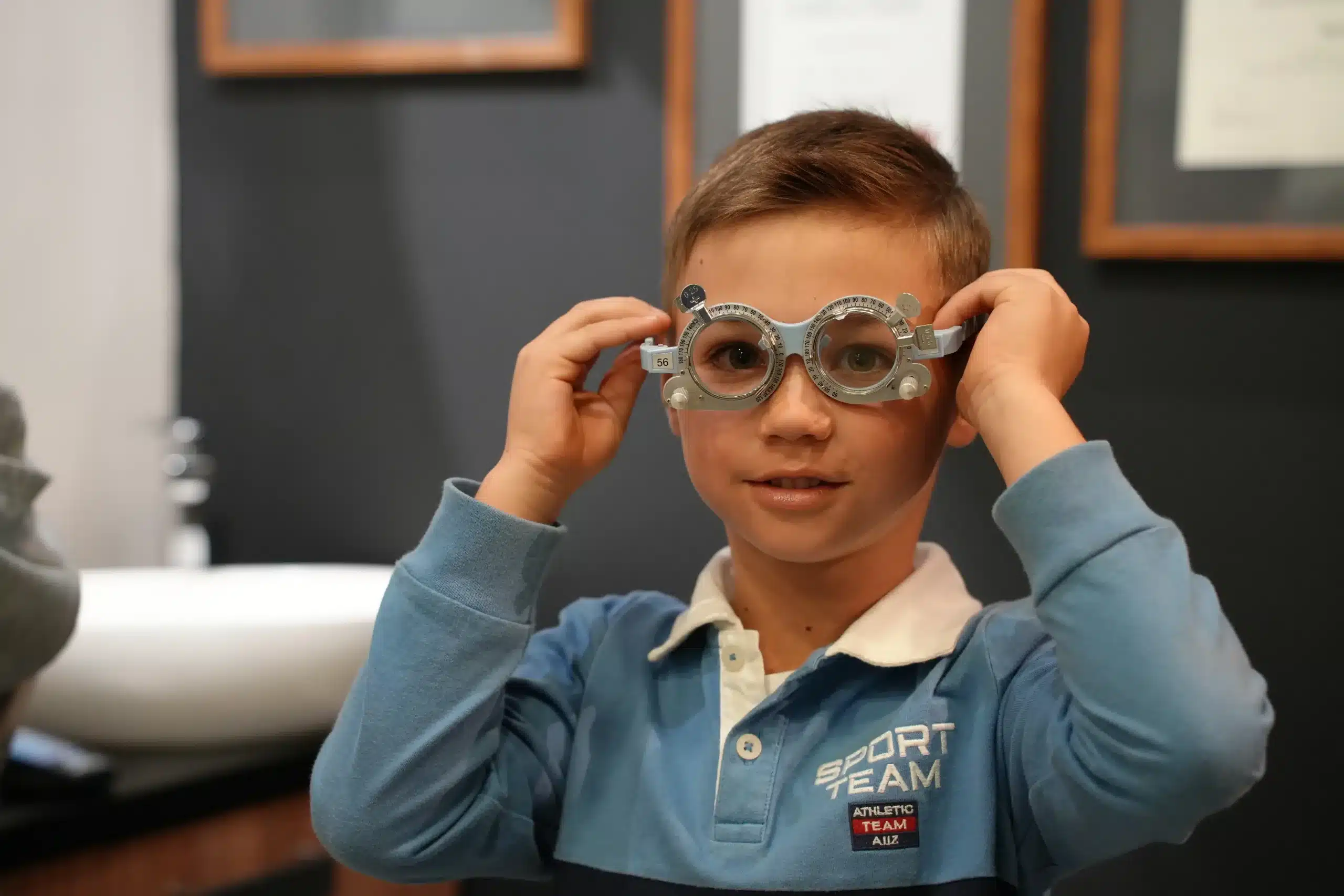
A children’s eye test at Reza Ferreira Optometrist is not simply a scaled-down version of an adult exam. The assessment is tailored specifically to how developing visual systems work and what can go wrong during critical stages of growth.
While we assess the standard elements, including visual acuity and general eye health, we go considerably deeper for children. Reza and her team examine:

Eye muscle function and coordination
Children’s eye muscles are still developing. Problems with how the muscles work together can cause strain, headaches, and reading difficulties that look, from the outside, like attention or learning problems.
Visual functions
This includes how well the visual system processes and interprets what the eyes see, not just how clearly the image arrives.
Reading vision
The visual demands of reading are very different from distance vision. A child can have perfectly clear distance vision and still struggle significantly with close work, which is where a large portion of their school day is spent.
Colour vision
Colour deficiency affects approximately 1 in 12 boys and 1 in 200 girls. Most children are never tested. Knowing early allows parents and teachers to adapt their approach in ways that make a genuine difference.
Depth perception
Binocular vision, meaning how well the two eyes work together to create a three-dimensional image, is tested as part of every child’s assessment.
A children’s eye test at our Paarl practice typically takes between 30 and 60 minutes, reflecting the depth and care involved.
The Warning Signs Every Paarl Parent Should Know
Children rarely complain that they cannot see clearly. They assume their experience of the world is normal because it is the only one they have ever known. That is why parents and teachers play such an important role in recognising the early signs.
These are the warning signs our team asks parents to watch for:
- Squinting to see clearly, particularly when looking at a board, screen, or anything at a distance
- Sitting very close to the television or holding devices and books unusually close to their face
- Frequent eye rubbing, not just when tired, but during tasks requiring focus
- Excessive blinking, especially when reading or concentrating
- Covering or closing one eye to see better is a significant sign that the two eyes are not working well together
- Tilting or turning the head when looking at something, which can indicate the child is trying to use a preferred eye or a clearer field of vision
If your child is showing one or more of these signs, an eye test should be your next step. Many of these behaviours are easily misread as inattention, restlessness, or a learning difficulty. In a number of cases, the correct prescription alone produces a significant improvement in school performance and concentration.
Myopia Is on the Rise, and Paarl Children Are Not Exempt
The most common vision problem Reza and the team are identifying in children right now is myopia, commonly known as short-sightedness. Children are arriving with poor distance vision that, without intervention, continues to worsen year on year.
This is a global trend, and the Paarl area is no different. Increased screen time, reduced time spent outdoors, and the demands of early schooling are all contributing factors. The important thing to understand is that myopia is progressive. The earlier it is identified and managed, the better the outcome for your child’s long-term vision.
Regular eye tests are the only reliable way to track this. A child who tested well at age five may well need attention by age eight.
How Paarl Schools Are Involved
Reza Ferreira Boutique Optometrists has a strong and active relationship with schools in the Paarl area. Local schools attend our dyslexia awareness evenings and regularly refer children to the practice when teachers notice signs that a child may need an assessment.
Many families also find us through word of mouth, a teacher’s recommendation, a conversation at the school gate, or a neighbour whose child went through a similar situation.
We are proud to be part of the Paarl community in a meaningful way, not just as a service provider, but as a resource for parents and educators navigating these questions together.
When Vision and Learning Intersect: The Dyslexia Evaluation
The connection between vision and learning difficulties is an area Reza Ferreira is particularly well-equipped to assess. Reza herself trained at the Stark-Griffin Dyslexia Academy (SGDA), and the practice is a certified SGDA partner, giving families in Paarl access to the only HPCSA-approved dyslexia test recognised by the Health Professions Council of South Africa. Very few optometrists in the Western Cape offer this.
It is worth understanding how the two assessments relate to each other.
A children’s eye test is the starting point. If our optometrists identify visual indicators during the eye test that suggest a possible learning-related visual difficulty, they will discuss the next steps with you.
A dyslexia evaluation is a separate, more extensive assessment that can also be requested independently. Importantly, a full eye test is always included as part of the dyslexia evaluation, because the process requires ruling out or identifying visual factors before drawing broader conclusions.
Dyslexia itself takes many forms. The evaluation at Reza Ferreira Optometrist identifies which type is present: visual dyslexia, auditory dyslexia, or sometimes a combination. This distinction matters because the appropriate support differs meaningfully depending on the type. The earliest dyslexia evaluations can be done from age nine, or when a child is in Grade 3.
A dyslexia evaluation takes approximately 90 minutes. Following the assessment, a full report is sent to both parents and the school, detailing the extent of the dyslexia and explaining the accommodations and actions that the school should put in place. The practice also works alongside a wider support network, including audiologists, speech therapists, educational psychologists, and learning academies, to ensure the best possible outcome for each child.
Medical Aid and Children’s Eye Tests
If your child is a registered medical aid member, their comprehensive eye test will be covered by their medical aid. We recommend confirming your specific benefit details with your scheme before your appointment.
Helping Your Child Feel at Ease
It is completely normal for children, especially young ones, to feel uncertain about a new experience. Channáh’s advice to parents is both practical and reassuring: frame the eye test as a game.
“We like to say we’re going to see how well you can see,” she explains. “We let children know what comes next at each step, and we make it clear that we’re just going to look at pictures and letters together.”
The practice environment at Drakenstein Mall is calm and welcoming, and the team is experienced in working with children at every temperament. There is no pressure, no rush, and nothing that should feel frightening. Preparing your child with a simple, honest explanation, such as “we’re going to look at some pictures and shapes, and the optometrist is going to check that your eyes are healthy,” is usually more than enough.
Book a Children’s Eye Test at Our Paarl Practice
Reza Ferreira Boutique Optometrists is located at Shop 25, Drakenstein Mall on Lustigan Road in Paarl, with easy access from the N1 and ample free parking for the whole family. We also welcome families travelling from Wellington, Franschhoek, and Stellenbosch.
If you have noticed any of the warning signs above, if your child is starting school, if it has been more than a year since their last test, or if you simply want the peace of mind that comes from knowing their vision has been professionally assessed, we would love to see them.
FAQs: Children’s Eye Tests in Paarl